## Zorkmid world / eCash ID
Open [the Zorkmid world](https://johnrigler.github.io/lantern/world.html) to play
Lantern while keeping the wider conversation nearby. Sign in with your printed
ID, post locally signed comments through a configurable File Proxy, or open
Chisel to prepare and explicitly broadcast a native eCash note/IPFS URI.
[Create and print an ID](https://johnrigler.github.io/lantern/onboard/) shows the full CTP500 card preview on your phone, with 90° view rotation. [World documentation](world/README.md).
# Zorkmid
**Create an eCash identity and print a Zorkmid card:** open the website and choose
**CREATE YOUR ZORKMID ID**, or open [`onboard/index.html`](onboard/index.html).
The current Pages route during the repository rename is
[ID onboarding](https://johnrigler.github.io/lantern/onboard/); opening the site
under `/zorkmid/` automatically uses that path in public ID links.
The browser creates or restores an eCash (XEC / Bitcoin ABC) mainnet key, provides
a public receiving identity at `id.html?address=…`, and prints a folded
WIF/public-ID card directly on the CTP500. The card and public identity use the Zorkmid symbol; avatar creation is paused.
Keys stay in the tab; avatar etching, transaction spending,
and token issuance are later work. [Onboarding details](onboard/README.md).
Lantern is an application within the Zorkmid world.
## Lantern
**Play classic text adventures in your browser.** Lantern is a playable Z-machine game interface, beginning with Zork I, with optional self-hosting and experiments in portable saves and player-held signatures.
▶ PLAY LANTERN NOW
·
Choose Zork 1, 2, or 3
The [homepage](https://johnrigler.github.io/lantern/) shows Zork 1, Zork 2, and Zork 3 with their subtitles and short taglines. Each choice opens the real game inside the Zorkmid world. The client connects to the default Frotz server at `https://rigler.org/lantern/`; availability depends on that server and its story files. [Game catalogue and source notes](docs/game-catalogue.md).
## How it works
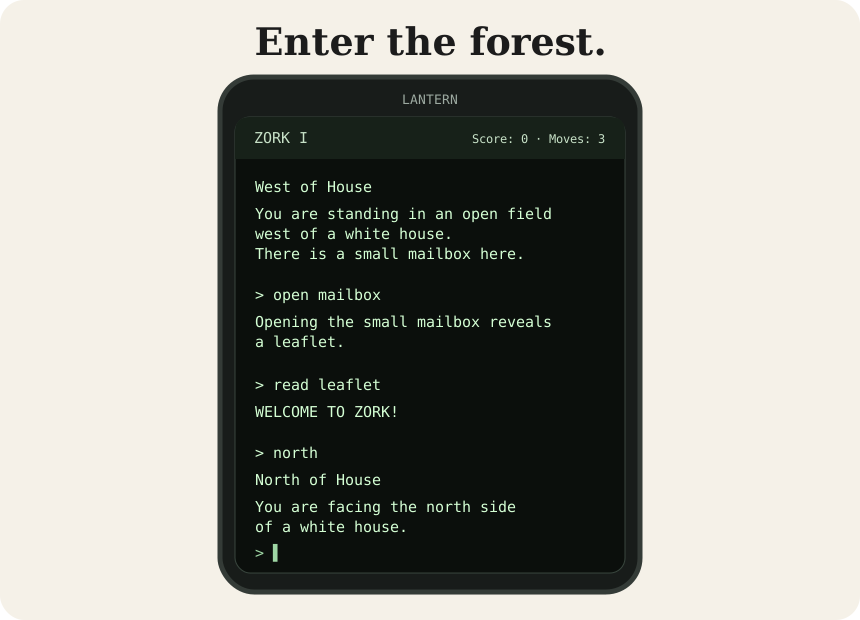
Choose a game, enter commands such as `north`, `open mailbox`, or `inventory`, and read what happens. The browser is a thin client; a Python server runs `dfrotz` with a compatible Z-machine story file. Save and load controls are available in the interface.
You can change the game server under **Settings**, including using your own server instead of `rigler.org`.
```text
Browser (GitHub Pages, IPFS, or local hosting)
↓ HTTP API
Lantern Python server
↓
dfrotz + your Z-machine story files
```
## The larger world behind Lantern
**Lantern is a doorway, not the destination.** Zorkmid is proposed as an entry currency and a familiar tokenomics interface to a much larger world built with [Chisel](https://github.com/johnrigler/chisel). The distinguishing advantage is not a promise that game activity will drive a token price. It is years of working with public ledger data, encodings, addresses, transaction construction, self-sovereign signing, and replaceable web infrastructure. Chisel makes those capabilities available as interoperable tools, not as a proprietary platform.
The possible digital social experience extends beyond a game, a token, or a single website: people can publish signed messages, record game outcomes, follow artifact histories, respond to one another, attach IPFS documents, and decide which issuers, communities, or rules they trust. Hosts and interfaces can be replaced. Many interactions need no Zorkmid at all.
One proposed example is **historical token-gated participation**. A participant signs an action when their address holds the required token balance. A verifier checks ownership at a specified block or transaction state and records an independently verifiable claim or receipt. The participant might later sell every token. That does not erase the historical eligibility of the earlier action. Other people can respond to the resulting record without themselves holding tokens, depending on the community's rules. This requires explicit chain-state proofs or reproducible state queries, signed authorship, and recorded verification context; a wallet balance inspected today does not establish a historical fact by itself.
This is the proposed **unfair advantage** relative to an ordinary token launch: an independently useful, extensible ecosystem is already under development, and token ownership is merely one possible input to its rules. [The Zorkmid white paper](ZORKMID-WHITEPAPER.md) describes the broader model and separates existing functionality from future integrations.
## Why the story matters
The [Zorkmid monetary white paper](ZORKMID-WHITEPAPER.md#i-b-the-proof-is-the-story-bridging-two-audiences) explains the proposed bridge between conventional investors and crypto users: a story makes an unfamiliar protocol accessible, but each claimed utility must end in an independently reproducible action, signature, transaction, or indexed record. The point is to **show what the token and surrounding infrastructure can do**, not to imply that demonstration guarantees token appreciation.
**[Verify a saved Lantern story in your browser](story-verifier.html)**. Load a saved `.lantern.json` file, calculate its canonical SHA-256, optionally compare an independently supplied digest, and export a proof envelope. This runs locally in the browser and does not claim to verify gameplay or blockchain publication.
## The proof-of-utility demonstration
[One Verifiable Story](STORY-PROOF.md) specifies an end-to-end Lantern session → canonical evidence → optional signatures → Chisel transaction reference → address-based independent verification. It distinguishes existing deterministic replay support from proposed signing and ledger integrations and provides concrete acceptance tests.
## Browser evidence verifier V1
[Open the standalone evidence verifier](verify.html) to canonicalize a `lantern.story.v1` JSON object, calculate its SHA-256 hash, and compare it with an independently supplied expected digest. The verifier uses browser Web Crypto and does not send the evidence to a server. **V1 does not verify gameplay, issuer signatures, or blockchain publication.** See [One Verifiable Story](STORY-PROOF.md) for the remaining stages.
## Run your own server
Lantern is not dependent on the default host. On a Linux machine, install Python and Frotz, provide compatible story files, and run the server:
```sh
sudo apt install frotz
python3 lantern.py
```
By default the server listens on port `7788`. For a remotely hosted HTTPS client, expose the API behind an HTTPS reverse proxy. The client can then use your server URL in **Settings**.
For details, see [Lantern setup and API notes](LANTERN.md), the [self-hosting section](https://johnrigler.github.io/lantern/#self-hosting), and [About Lantern](about.html).
## Background and experiments
Lantern began as **Zarkmid**, a project named for the fictional currency in Infocom's Zork games. Earlier experiments explored referencing game saves from Dogecoin transactions. The current implementation uses Python and Frotz, and explores user-held cryptographic identities, portable game saves, and optional payments for independently operated hosting.
The game files are separate from the client and server code. Only distribute story files you have rights to use. For Frotz, see [the Frotz project](https://gitlab.com/DavidGriffith/frotz); for historical Infocom downloads, see [infocom-if.org](https://infocom-if.org/downloads/downloads.html).
**Zorkmid:** [Read the in-world monetary white paper](ZORKMID-WHITEPAPER.md). This is a proposed currency and financing design, not a deployed token or investment offering.
**Links:** [Play the game](https://johnrigler.github.io/lantern/lantern.html) · [Lantern homepage](https://johnrigler.github.io/lantern/) · [Technical notes](LANTERN.md) · [Attestation proposal](ATTESTATION-PROPOSAL.md)
## Cross-chain Zorkmid lobby
See [the cross-chain lobby architecture](docs/zorkmid-cross-chain-lobby.md) for the proposed no-token Mogwai commons, optional token-gated recognition on EVM/Solana, user-created and officially verified badges, and recovery of application indexes from original ledger records. This is a design proposal, not a deployed cross-chain service.
## ETHDenver 2027 coordination
See [the project-specific ETHDenver / Zorkmid notes](docs/zorkmid-ethdenver-experience.md) for the proposed physical dartboard demonstration, conference materials, optional Zorkmid/ Base integration, and delivery gates. These are plans, not claims that a token, venue, or showcase is live.