← Chapter 1: There Is No Spoon
The Address Is the Index
Writing directly into the ledger before rebuilding the application stack around it.
Where we are. The previous chapter described stack capture: useful tools become expected clues, and then unfamiliar systems are judged by whether those clues are present. This chapter asks the reader to carry that problem forward. The example here will look too small if you are waiting for a token, a smart contract, a backend, an account system, or a conventional Web3 application. The claim is lower-level than those things.
The claim: cryptocurrency already gives us a durable public address space and an ordered public transaction history. I do not see why that address space cannot also be used as a shared public index, using deliberately constructed, obviously non-wallet addresses as human-readable labels.
By shared public index, I do not mean a centralized index owned by one company. I mean a common coordinate system: an address can become a durable place under which transactions and references accumulate, and another reader can reconstruct that history from the ledger.
1. A different kind of blockchain user
It may help to begin with the kind of person making the argument.
I am not primarily approaching a blockchain as a place to launch a new currency, create a financial product, or build a company around a smart contract.
I am the sort of user who notices that the ledger is already public, already ordered, already checksummed, already replicated, and already full of fields that I can control when I create a transaction.
So I put messages there.
That behavior is unusual enough that it is easy to misread. The conventional question is often: what application are you building on top of the blockchain?
My earlier question is: what is already possible inside the transaction itself?
This difference is exactly the kind of difference Chapter 1 was about. If you begin by looking for the normal Web3 stack, you can miss the object because the object is underneath the stack.
2. Start with Bitcoin itself
Bitcoin is normally introduced as digital money. That is reasonable. Money is the use that made the system historically important.
But the ledger has always contained more than bare numbers.
The Bitcoin genesis block includes a human-readable newspaper headline in its coinbase data: a reference to The Times of London on 3 January 2009. The important point here is modest. Bitcoin began with human language embedded directly in the record.

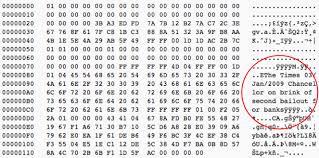
This does not prove that Bitcoin was intended to become a publishing system. It shows something more basic: protocol data and human meaning can occupy the same durable record.
3. A transaction is also a record
A cryptocurrency transaction is usually explained as movement of value.
But technically it is also a signed, ordered data structure that becomes part of a public history.
Depending on the blockchain, a transaction can contain or determine things such as:
- which previous funds are being used;
- which addresses or scripts receive outputs;
- the order of those outputs;
- their values;
- small explicit data fields;
- a transaction identifier;
- a position in the larger chain history.
The financial interpretation is real. It is not the only property of the structure.
signed transaction → public ordering → durable reference → independently retrievable bytes
Once you notice those properties, another question appears: can some of the fields be deliberately chosen so that the transaction is also readable?
4. What an address normally means
A cryptocurrency address is normally presented as a destination for payment.
You generate a private key. From that key, software derives public information and eventually an address. Someone sends value to that address. The holder of the private key can later authorize spending under the network's rules.
So the cultural meaning of an address becomes:
address = wallet destination = money belongs here
That is the normal use.
But on several cryptocurrency systems, an address is also a fixed-format string with a network prefix, a payload, and a checksum or comparable validation structure.
The software checks whether the string is structurally valid. It does not ask whether the string looks like language to a human being.
That gap is where this project begins.
5. The address can be the index
Suppose an address is not generated in the ordinary way from a private key you intend to use.
Instead, suppose you deliberately construct the payload so that much of the resulting address contains readable language, then calculate the required checksum so the network and ordinary software still recognize it as a valid address.
Now the address can function in two worlds at once.
To ordinary cryptocurrency software, it is an address.
To a human reader using a published convention, it is a label.
For example, one of the address conventions used by this project can produce strings in which the readable portion occupies almost the entire address:
DCxDoMoxARiGATozzzzzzzzzzzzzVwQnWq
The exact grammar is not important yet. What matters is that this is not a vanity address discovered by repeatedly generating keys until a few desired letters happen to appear. The readable payload is deliberately constructed, and the checksum is then made valid for the selected chain.
That changes the conceptual role of the address.
If an address can be a durable human-readable label, then transactions associated with that address can form a durable public index under that label.
The index is not a new blockchain feature. It is a new use of address space that already exists.
6. “Obviously unspendable,” technically precise
In ordinary conversation I call these unspendable addresses because their purpose is visually obvious: they are full of language or padding and were not created as wallets whose private keys I intend to hold.
That human description needs one technical qualification.
Provably unspendable output: some transaction outputs are constructed so their script cannot succeed. A common Bitcoin-family example is an OP_RETURN output. The impossibility of spending is explicit in the script.
Human-readable carrier or burn-style address: a syntactically valid address constructed from selected bytes rather than generated from a retained private key. No usable private key is known to the author. In practical terms the output is intended to be burned, but that is different from a mathematical proof that no key preimage could exist.
The distinction matters for technical accuracy, but it does not weaken the indexing idea.
The point of the readable address is not that the blockchain has been taught a new kind of script. The point is that a valid address can also carry a human-readable label, and the ledger can accumulate transactions associated with that label.
7. Putting language into address space
Once this is possible, an encoding grammar can make the labels more systematic.
A prefix can identify what kind of thing the address names. Reserved characters can stand for spaces or separators. Padding can fill unused positions. The final checksum remains whatever the selected network requires.
A human-readable address can therefore behave less like a bank account number and more like a small public inscription.
Different address families can mark different categories: a person, a subject, a transport, a text fragment, or a pointer into another storage system.
The blockchain does not understand those categories.
People and software do.
That distinction is important. No consensus change is required. No miners or validators need to agree that a particular prefix means “person” or “subject.” The ledger only needs to preserve the transaction exactly as it already does.
8. A wall of real addresses
Before going further, it helps to simply look at these for a while. The following are not hypothetical examples invented for this chapter. They are addresses preserved in the Chisel project's bundled Dogecoin ledger data, plus the DigiByte YouTube address preserved in the original unspendable repository.
DCxxxxFiNNEGANSxWAKEzzzzzzzzyYeZHb
“FINNEGANS WAKE” occupying the address payload. Bundled at Dogecoin block 2,764,925.
DCxFLYiNGxSPAGHETTixMoNSTERzY96vdG
“FLYING SPAGHETTI MONSTER.” Bundled at Dogecoin block 2,928,639.
DCxFREExSPEECHzzzzzzzzzzzzzzYjS7L6
“FREE SPEECH.” Bundled at Dogecoin block 3,273,847.
DCxLiNExMESSAGESvxAxLARGEzzzbw4RHd
A message-like subject carried directly in address space.
DBxDoGExToxDiGiBYTEzzzzzzzzzVG1Un7
A DBx transport label: “DOGE TO DIGIBYTE.”
DBxDiGiBYTExTUNNELzzzzzzzzzzdQazZG
Another transport label: “DIGIBYTE TUNNEL.”
DBxYoUTUBEvCoMzzzzzzzzzzzzzzZ31xMU
The DigiByte YouTube transport/index address preserved in the original unspendable documentation.
DCxHASHTANGLEMENTzzzzzzzzzzzWQovPd
“HASHTANGLEMENT,” linked from the Chisel archive to a DigiByte address-history page.
The visual effect matters. A normal cryptocurrency address looks random. These do not. They look like somebody wrote on the ledger because that is, functionally, what happened.
94d0ed27787dc531e86683680d3975d93f3db79c6f76442d4b99a93885328832This panel is a simplified explorer-style rendering of literal ledger data in Chisel's bundled Dogecoin feed. A live explorer may present the same fields differently or cease operating; the transaction and address are the durable references.
9. How an address becomes an index
The next step is the part I think is easiest to overlook because block explorers already make it look ordinary.
Block explorers commonly group transaction history by address. Enter an address and the explorer shows transactions associated with it.
That interface is normally interpreted financially: this is the history of money associated with an account-like destination.
But if the address itself is a readable subject label, the same grouping becomes something else.
readable address → shared coordinate → transactions → ordered public history
A subject address can accumulate references. A person address can accumulate attestations or publications. A document address can accumulate revisions. An address can point outward to larger content. A later reader can inspect the history without first asking the original application for its database.
This is what I mean by using the address space as an index.
It is “central” only in the sense that many different readers can converge on the same coordinate. It is not centralized around one operator.
Explorer interfaces are convenient, but they are not the durable part. An explorer can disappear or change its search behavior. The underlying transactions can still be reconstructed from another explorer, an indexer, or a local node.
So the stronger formulation is:
ledger record + address convention + published grammar + independent reader
10. A real index: YouTube
The DigiByte YouTube address makes the indexing claim easier to see:
This is the conceptual jump. The address does not need to represent one video. It can represent YouTube as the transport. Individual transactions can then add specific videos, subjects, people, or other coordinates. The address becomes a meeting point among records.
That means the index can be relational without needing one master SQL database. A transaction can touch more than one readable coordinate. One coordinate can mean the transport, another the subject, another a person. Later software can reconstruct the intersections.
YouTube transport address + subject address + person address + transaction → one durable relation
At this point the block explorer stops looking merely like a wallet-history screen. It starts looking like a crude database browser whose keys happen to be public ledger addresses.
11. Why this looks wrong from inside the normal stack
At this point Chapter 1 should be doing useful work.
A reader trained on modern Web3 may instinctively ask:
- Where is the smart contract that defines the index?
- Where is the database?
- Where is the backend service?
- Where is the token?
- Where is the account system?
- Where is the schema registry?
- Who owns the namespace?
Those questions come from recognizable architectures.
But the experiment here is specifically to see how much can be done before those layers are added.
This is not an attempt to replace Bitcoin, Ethereum, or another mature distributed ledger with a new trust system. It is almost the opposite. The experiment begins by accepting the expensive distributed machinery that already exists, then asking what else can be built from its existing coordinates, signatures, transaction ordering, and public history.
The architectural wager is conservative at the bottom and unusual at the top: do not introduce a new consensus mechanism merely to recover properties the ledger already has.
Stop rebuilding the distributed layer. Use it.
The address is already globally valid according to the chain's rules. The transaction history is already public. The checksum is already validated. The ordering is already preserved. The transaction identifier is already a durable citation.
If I add a company database merely so the index looks like an application database, I may make the system easier to recognize while making the underlying idea harder to see.
This is the practical collision with stack capture:
The missing pieces are not always unfinished work. Sometimes the missing pieces are the result.
12. The same carrier can hold other structure
Once an address is understood as a fixed-width carrier rather than only as a payment destination, text is not the only possible interpretation.
Earlier Chisel experiments used address-sized rows to encode highly compressed raster images. A restricted alphabet represented colors and repeated runs. Multiple ordered addresses reconstructed the image.
#0 SNMMMBQXiiiiisrrrriiXQBBMMM12AD3f
#1 SNMMMBQXiiiippuuuuurriiiQQBMM91PT7E
#2 SNMMMBQXipppppuppupppiXXQMM9bcs4i
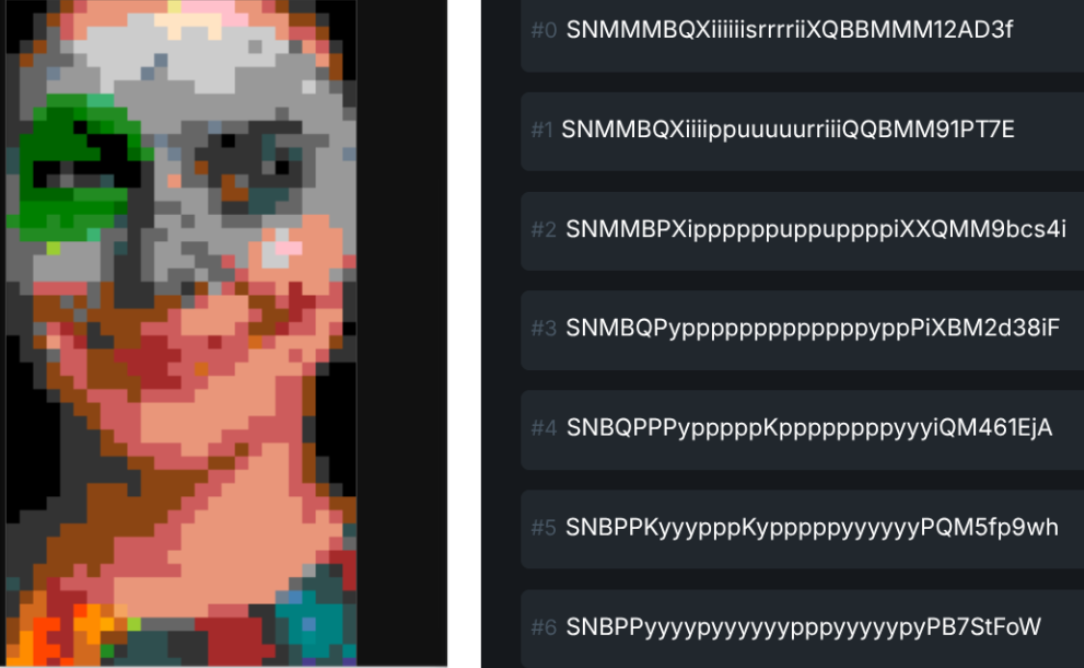
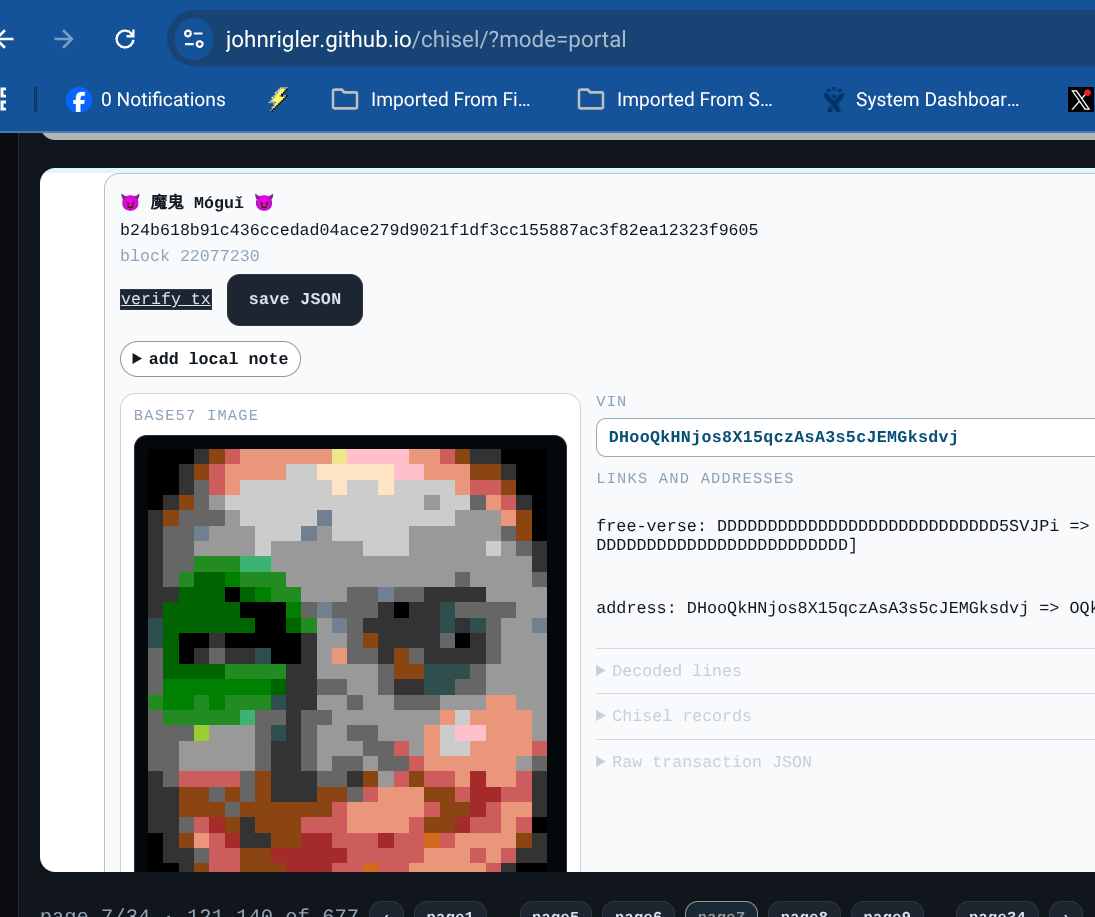
This is not the central claim of the chapter. It is evidence that once the address is treated as a carrier, other interpretations become possible.
13. The EVM without starting from a contract
The same habit of looking underneath the expected stack applies to Ethereum-family chains.
Ethereum is usually introduced through smart contracts. That makes sense because the EVM made programmable shared state extraordinarily useful.
But an Ethereum-style transaction also contains ordinary fields: sender, receiver, value, and an optional data field. Those fields exist before we decide that every meaningful application must begin with a large smart contract.
So Chisel can also read deliberately chosen transaction data or receiver addresses as carriers.
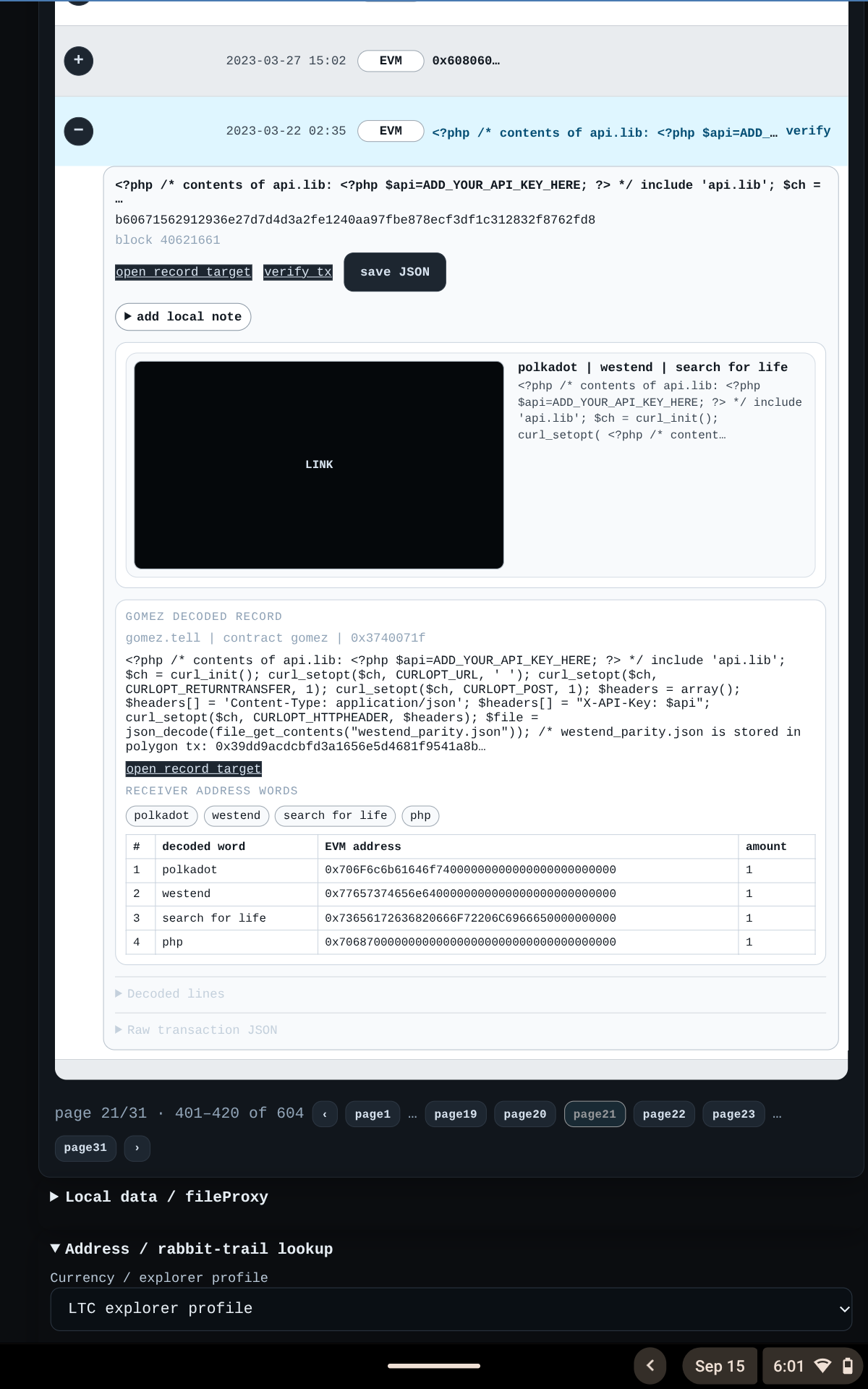
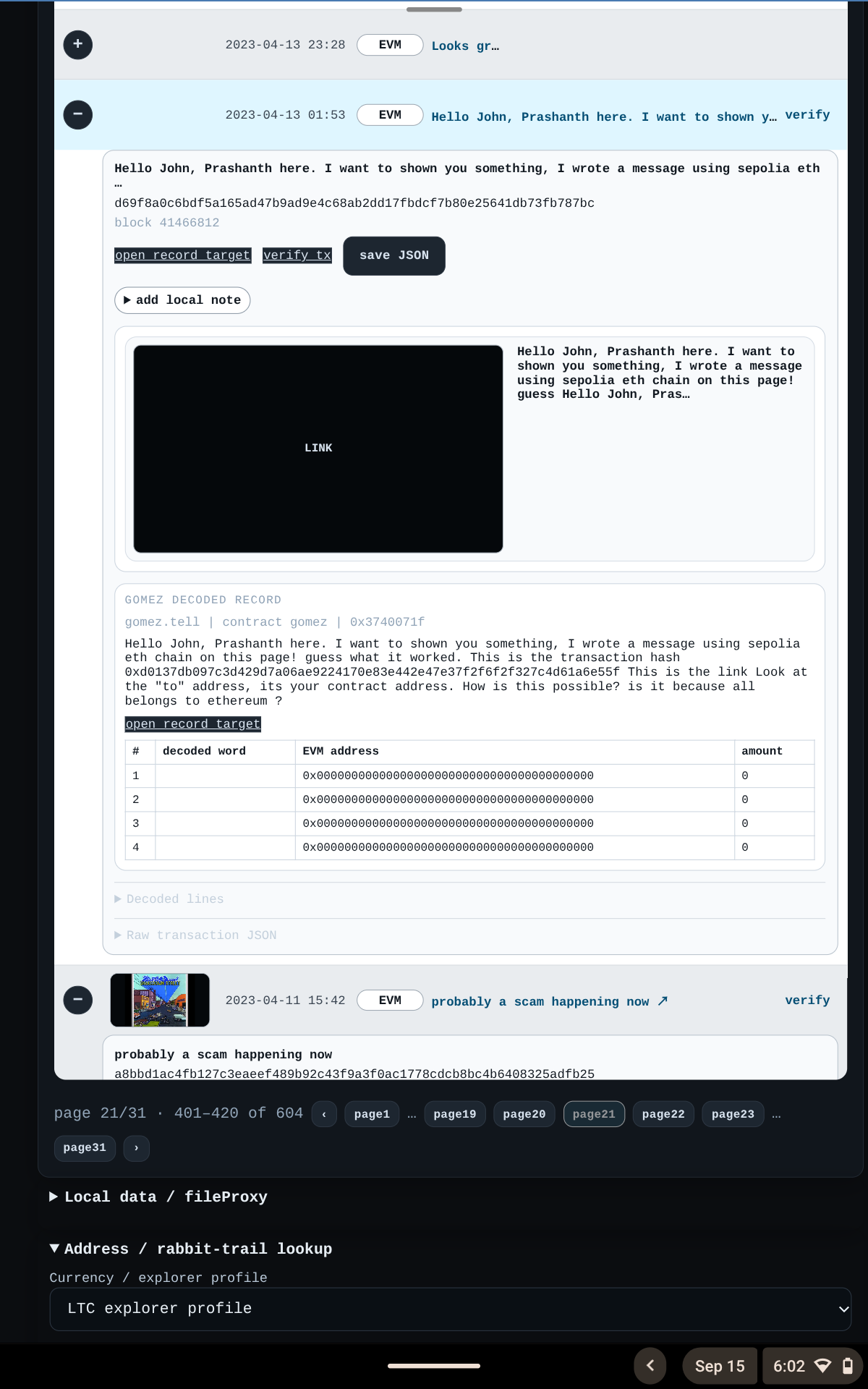
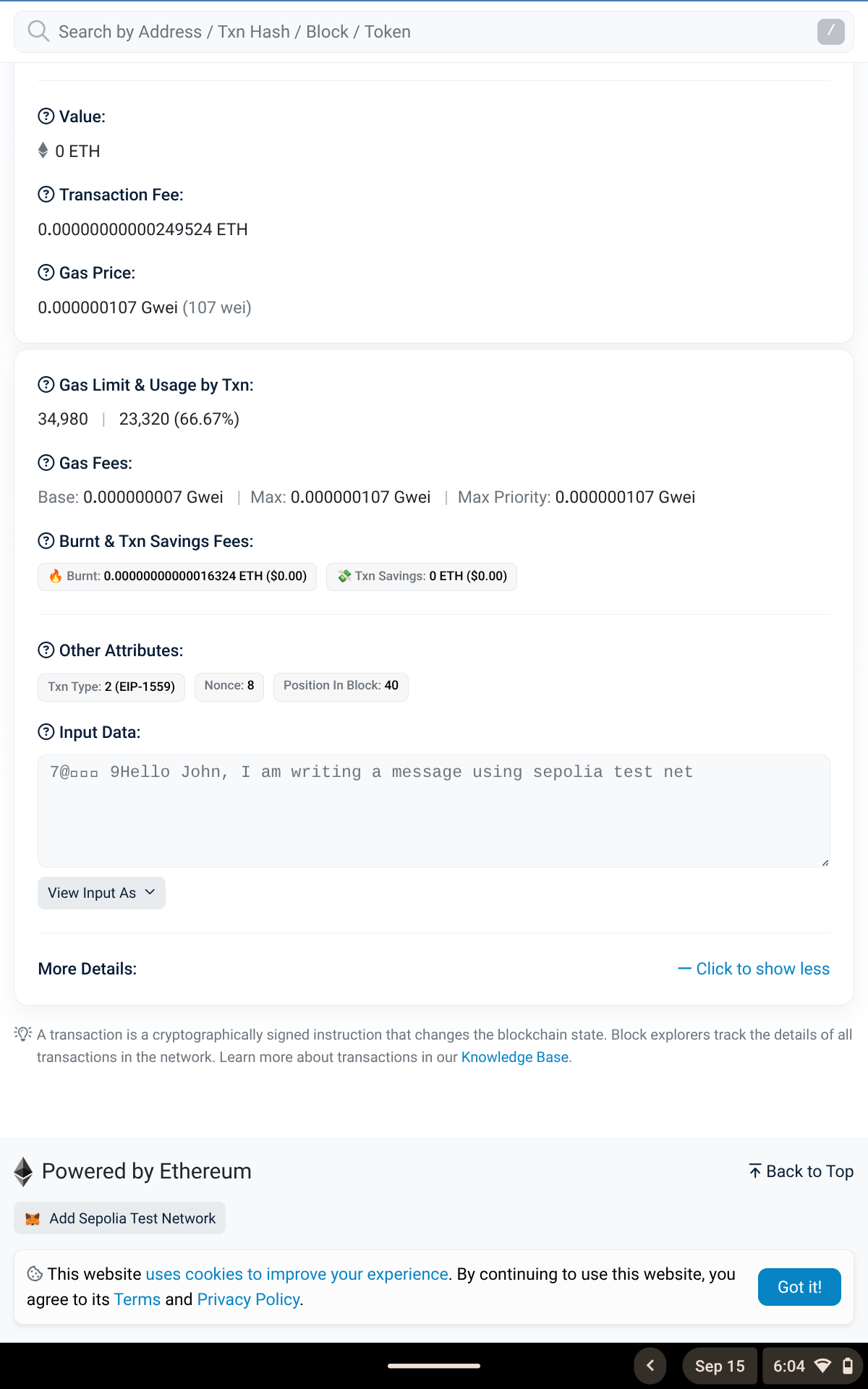
Again, the point is not that smart contracts are unnecessary. The point is that a smart contract should enter because its semantics are required, not because “Web3 project” has become synonymous with “smart-contract application.”
14. What the ledger knows, and what it does not
The blockchain does not know that an address contains a word.
It does not know that one address means a person and another means a subject.
It does not know that a sequence of address rows represents an image.
It does not know whether a human-readable statement is true.
The ledger contributes something narrower:
- the exact transaction bytes;
- their ordering;
- network validation according to consensus rules;
- a durable transaction identifier;
- replication across independent systems.
The interpretation comes from a published grammar.
That means the durable object is not merely “data on a blockchain.” It is:
ledger bytes + published grammar + independent implementation
This also imposes limits. A readable carrier is not automatically an identity. A public statement is not automatically true. An address explorer is not consensus. A content hash does not guarantee availability. Browser-local signing is not automatically safe if malicious code was delivered to the browser.
The technique should be judged on the narrower claim it actually makes.
15. The smaller claim
The claim in this chapter is deliberately smaller than “blockchain changes everything.”
It is that cryptocurrency address space is already a public, machine-validated coordinate system, and transaction history is already an ordered public record.
If people deliberately create addresses that are visibly not ordinary wallet destinations, fill those addresses with readable structure, and publish the grammar used to interpret them, then those addresses can function as durable public labels.
Transactions associated with those labels can then function as a public index.
No token is required to make the label meaningful.
No smart contract is required merely to declare that the label exists.
No company database is required to be the only surviving copy of the history.
That absence matters economically as well as technically. A database, hosted namespace, proprietary API, or mandatory application can become a control point around which a conventional company is financed. An address grammar and public transaction history are less naturally captured that way because another reader can reconstruct them without permission.
This may make the model less attractive to institutions that expect a proprietary layer. It is also part of the point.
Those things may still be useful later. But they are later questions.
The experiment begins by asking what the ledger already gives us before the stack tells us what we are supposed to build.
Chisel is simply the working tool through which I have been exploring that question.
The next chapter asks what follows if this indexing model is taken seriously: identity that is not issued by an application, reputation that can accumulate without one platform owning it, and payment that can sit beside other public meaning rather than swallowing the entire medium.
Technical caution
Human-readable burn-style addresses should not be described as mathematically impossible to spend unless the locking script itself makes that true. The project uses “unspendable” colloquially for addresses intentionally constructed without a retained private key, while distinguishing those from provably unspendable outputs such as compatible OP_RETURN scripts. These experiments should not be used to protect funds or credentials whose loss would matter without independent review.